








GPU vs CPU vs ASIC mining
How CPUs, GPUs and ASICs differ as mining hardware: what each one is good at, where each falls short, and which coins suit which of them.
Which hardware mines which coins?
Mining hardware comes in three kinds: CPUs, GPUs and ASICs. Each one suits different coins, depending on the algorithm the coin uses.
| Hardware | What it is | Where it fits |
|---|---|---|
| CPU | A general-purpose processor | A few CPU-friendly algorithms; too slow for most coins |
| GPU | Thousands of small cores for parallel maths | Many coins; reusable for gaming, AI or resale |
| ASIC | A chip built for one algorithm only | Its one coin, such as Bitcoin; useless for anything else |
What is CPU mining?
A CPU is the general-purpose processor in every computer. It is flexible, but not specialised for the repetitive maths of mining.
A few algorithms are designed to stay CPU-friendly. For most coins, though, a CPU is far too slow to be worth the power. Mining started on CPUs, and most coins left them behind long ago.
What is GPU mining?
A GPU is a graphics card. It has thousands of small cores built for parallel maths, which is exactly what most mining algorithms need.
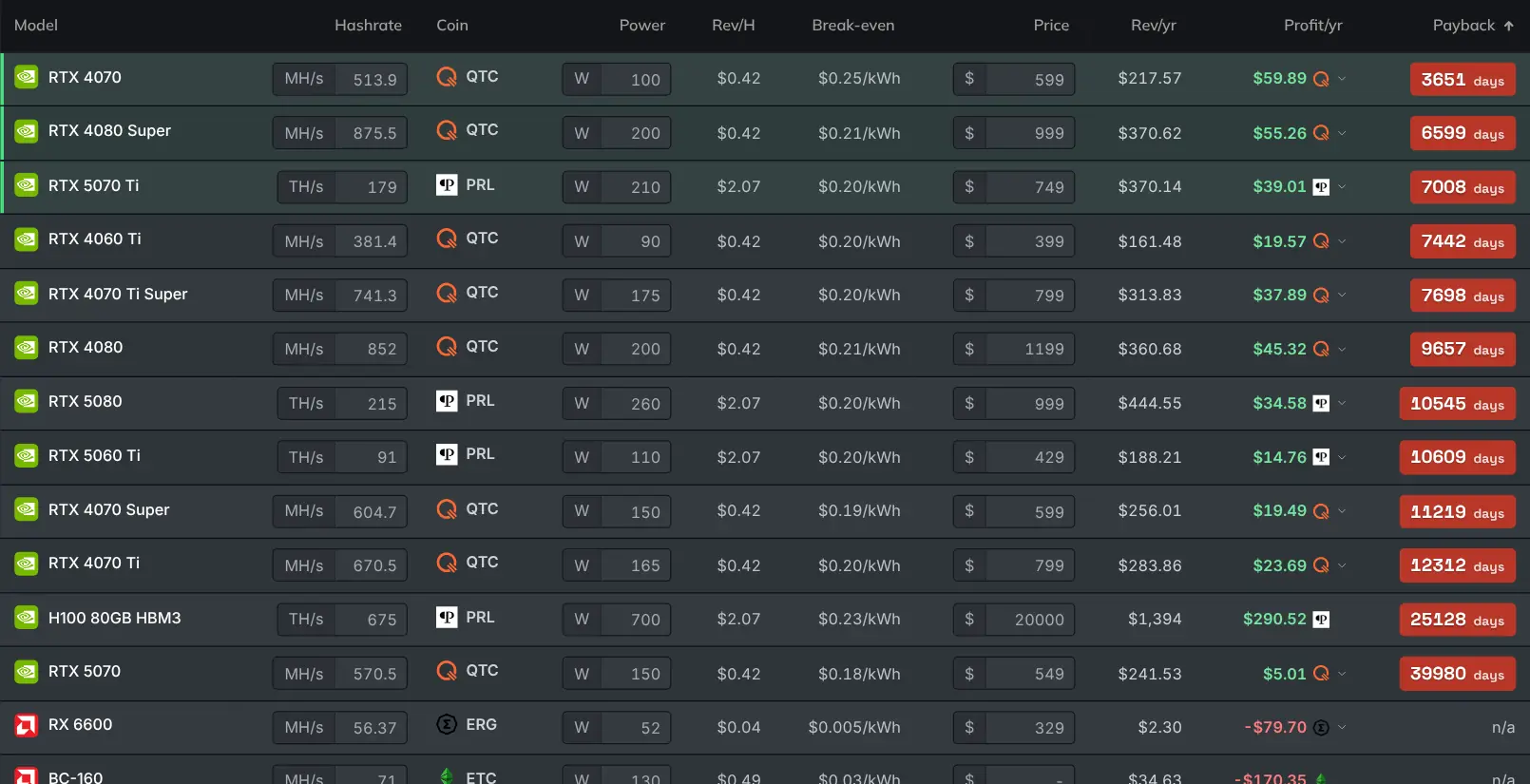
GPUs are the sweet spot for many coins. They are powerful and widely available. You can also reuse them for gaming, AI or resale.
Pearl is a GPU coin. Its useful-work algorithm needs modern cards with tensor cores.
What is ASIC mining?
An ASIC is a chip built to run exactly one algorithm and nothing else. That makes it extremely fast and efficient for its coin.
But an ASIC is useless for anything else. It also becomes obsolete quickly when difficulty climbs.
ASICs dominate coins like Bitcoin. They cannot mine a GPU coin like Pearl.

Which hardware should you use for Pearl?
For Pearl the answer is simple: a modern GPU.
- The algorithm relies on tensor cores.
- It runs on NVIDIA RTX 20-series cards and newer, and on supported AMD and Intel cards.
- Newer NVIDIA RTX cards are the fastest.
- CPUs are not suited to it.
- No ASIC exists for it.