








Pearl FP8 fork: will your GPU still mine?
What the planned Pearl FP8 fork (PIP-3) changes, which GPUs keep mining PEARL and which drop out, and what to do while no fork block is set.
The short answer
Pearl plans a hard fork, a rule change old software will not accept. It is known as the FP8 fork and is described in the proposal PIP-3. It changes the math a miner proves from integers to FP8, an 8-bit floating point format.
As written today, only NVIDIA GPUs from two chip families can mine after it: Hopper and Blackwell. Every other card that mines Pearl today would stop mining Pearl at the fork block. That includes the GeForce RTX 40, 30 and 20 series and all AMD and Intel GPUs.
Nothing is scheduled yet. PIP-3 is a draft, the code is still under review, and no fork block has been set. Until one is, every miner and every card keeps working exactly as now.
Which GPUs keep mining?
| Chip family | Example cards | After the FP8 fork, as drafted |
|---|---|---|
| Hopper | H100, H200 | Keeps mining |
| Blackwell, data center | B200 | Keeps mining |
| Blackwell, workstation and gaming | RTX PRO 6000, GeForce RTX 50 series | Keeps mining |
| Ada | GeForce RTX 40 series, L40S | Stops at the fork block |
| Ampere | GeForce RTX 30 series, A100 | Stops at the fork block |
| Turing | GeForce RTX 20 series | Stops at the fork block |
| AMD and Intel | Radeon and Arc cards | Stops at the fork block |
Two things are not known yet. One is how much GPU memory a card will need. The other is whether today's mining programs will add the new scheme. Both depend on the final release and on each miner's developers.
Why only two chip families?
Today a Pearl share proves integer matrix multiplication. Integer math gives the same answer on every chip.
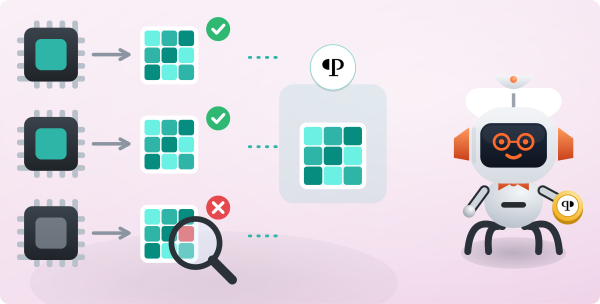
FP8 is floating point, and its results can differ in the last bit between chip families. That is because each family adds up and rounds numbers in its own way.
The network cannot accept a result that is only close. PIP-3 explains why: any tolerance in the check would let a miner nudge the output. That miner would collect extra lottery tickets without doing more work.
So every node must repeat the miner's math exactly, bit for bit. That is only possible on hardware the node knows how to reproduce.
This is why a miner declares its chip family inside the proof. Only families on a list can be declared, and PIP-3 lists Hopper and Blackwell. An RTX 40 card can do FP8 math in hardware. But Ada is not on the list, so the card has no valid way to prove its work.
What should I do now?
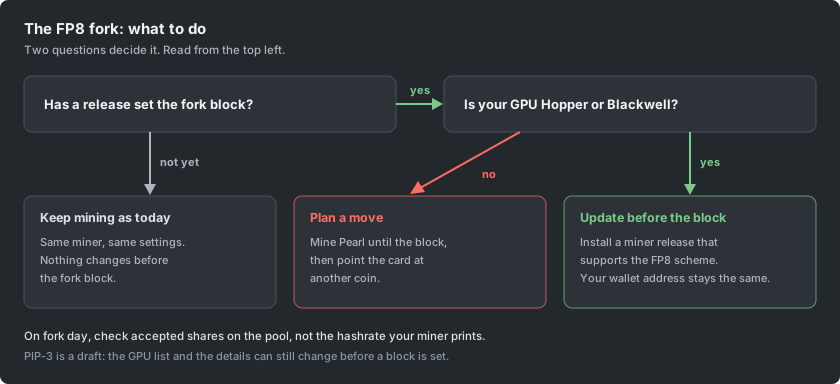
- While no fork block is set, change nothing. Your miner, your settings and your payouts stay as they are.
- Find your card's chip family in the table above.
- Hopper or Blackwell: once a miner release supports the FP8 scheme, install it before the fork block.
- Any other card: keep mining Pearl until the fork block. Decide in advance which coin the card mines next, so the switch takes minutes.
- On fork day, check your accepted shares on the pool dashboard, not the hashrate your miner prints. An outdated miner can show a normal hashrate while none of its shares count.
- Buying hardware for Pearl? A draft can still change. Wait for a release that sets the fork block before you buy for the new list.
Common questions
When is the fork? There is no date. A Pearl fork activates at a block height written into a node release, and no release has one for FP8 yet.
The latest Pearl release when this article was written was v1.5.7, from 12 November 2026. It contains no FP8 code.
Does my wallet address change? No. The fork changes how mining work is proven, not addresses or balances.
Do I need to upgrade anything if I mine on a pool? You do not run a node when you mine on a pool, so there is no node to upgrade. What matters is your GPU and a miner version that supports the new scheme.
Why is Pearl doing this? Almost all AI models run in floating point, and real AI inference already multiplies in FP8. PIP-3 builds the mining proof on that same step. So mining can ride along with useful model work, at less overhead than the integer scheme.
Where does this information come from?
- The scheme, the hardware list and the open questions come from the text of PIP-3. It sits in the Pearl team's public proposals repository, published on 30 July 2026 with the status Draft.
- The list of cards comes from the reference miner on the FP8 development branch of the Pearl source code. It names the chips it loads on.
- The status comes from the network settings in that code, where the FP8 fork height is set only for local test networks. It also comes from the latest release.
Where the sources say nothing, this article says so rather than guessing.